 Kreasof AI
Experiment archive · Stage I
ATMA Ablation Archive
Filter every 1B-token recipe-selection run, rank metrics at each evaluation length, inspect resolved configurations, and compare validation trajectories.
This archive supports a research article currently under review. Stage I selects a recipe across nuisance-factor settings; it is not a seed study or a substitute for the larger matched comparison.
Interactive evidence
Explore the factorial
Choose a metric, filter the recipe axes, then select rows to compare validation trajectories.
Validation trajectory
The top three ranked cells start selected. Use the Compare column below to add or remove trajectories.
Ranked cells
Click a row to inspect its metrics and fully resolved configuration.
Stage II · matched comparison
The promoted recipe at 9.816B tokens
The matched attention variants use memory, no local window, no distractor alignment, length-2K training, and the same L40S environment. Raven models are separately optimized comparison points.
| Group | Model | Token @2K | Token @256K | Exact @256K | BABILong @256K | BPB ratio | Base mean |
|---|---|---|---|---|---|---|---|
| Matched | NoPE | 99.2% | 0.6% | 0.0% | 0% | 5.65× | 45.15% |
| Matched | Polar | 98.9% | 34.4% | 9.0% | 28% | 1.26× | 43.29% |
| Matched | RoPE | 88.2% | 0.0% | 0.0% | 14% | 1.75× | 44.60% |
| Separately optimized recurrent family | |||||||
| Raven / AdamW | Atma-Raven-Titans | 43.1% | 10.0% | 0.0% | 38% | 1.02× | 43.05% |
| Raven / AdamW | Raven Native | 41.1% | 20.3% | 0.0% | 46% | 1.01× | 43.05% |
Retrieval averages tasks, haystack suites, and needle depths. Exact requires all five target tokens under teacher forcing. BPB averages three fixed-target datasets. Base mean averages eight 2K zero-shot tasks.
Post-hoc diagnostic · inference only
One extreme retention head mediates part of the extrapolation failure
A parameter scan found maximum zero-input half-lives of 21.01M tokens in NoPE, 3.07M in Polar, and 682 in RoPE. We capped only the largest runtime head at a 256-token half-life without rewriting checkpoint weights, then reran downstream, retrieval, fixed-target BPB, and BABILong.
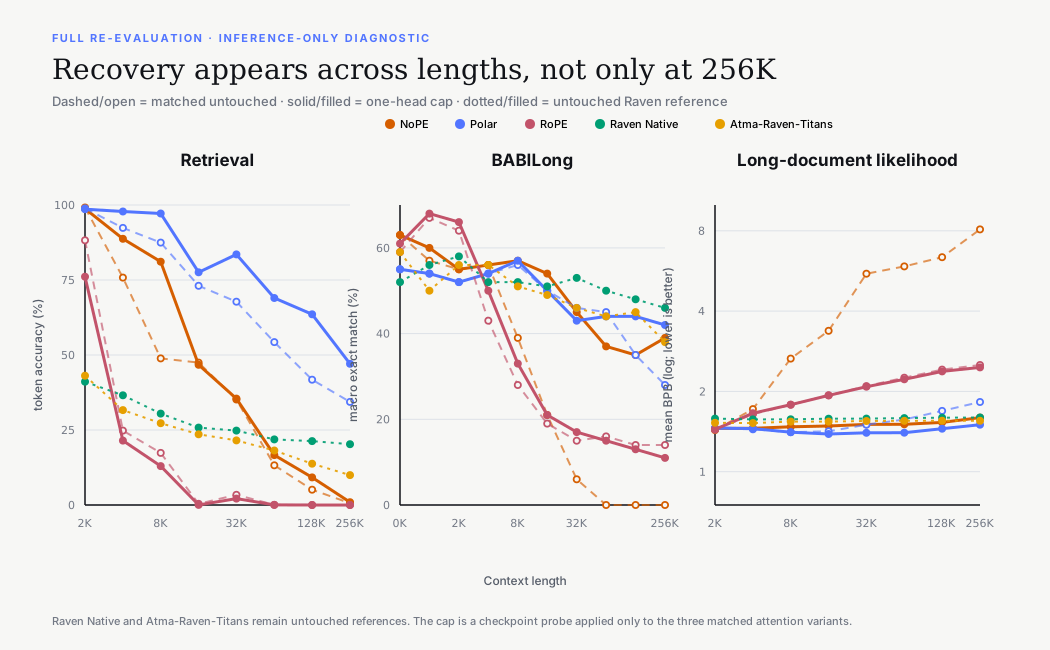
| Model | Max half-life | Base mean | BPB @256K | Retrieval @256K token / exact | BABILong @256K |
|---|---|---|---|---|---|
| NoPE | 21.01M | 45.15 → 45.10 | 8.097 → 1.595 | 0.60 / 0.00 → 0.93 / 0.00 | 0 → 39 |
| Polar | 3.07M | 43.29 → 43.25 | 1.825 → 1.501 | 34.37 / 9.00 → 47.07 / 16.33 | 28 → 42 |
| RoPE | 682 | 44.60 → 44.66 | 2.512 → 2.460 | 0.00 / 0.00 → 0.00 / 0.00 | 14 → 11 |
Baseline → capped. The full rerun compares clamped jobs with pinned archived baselines; a separate same-process paired sweep establishes the intervention. NoPE exact retrieval remains zero and RoPE does not recover, so the cap is a selective mechanism probe rather than a universal improvement. The paper appendix reports every downstream task and every retrieval, BPB, and BABILong length cell.
Metric definitions and composite scores
Length-weighted metrics use weight L / 2048, emphasizing extrapolation endpoints. Composite indices are exploratory archive aids and are not article headline metrics.